VIOM
VIOM computes weights estimates under Variance-Inflation Model
Description
Examples
 VIOM with default input.
VIOM with default input.
n=200;
p=3;
randn('state', 123456);
X=randn(n,p);
y=randn(n,1);
y(1:5)=y(1:5)*2;
[out]=VIOM(y,X, 1:5);
% Show the weights associated to each unit.
figure
boxplot(out.w)
out.w(1:5);
for i=1:n
if out.w(i)<0.9
text(0.8,out.w(i),num2str(i))
end
end
title('Weights associated to each unit')
out.beta;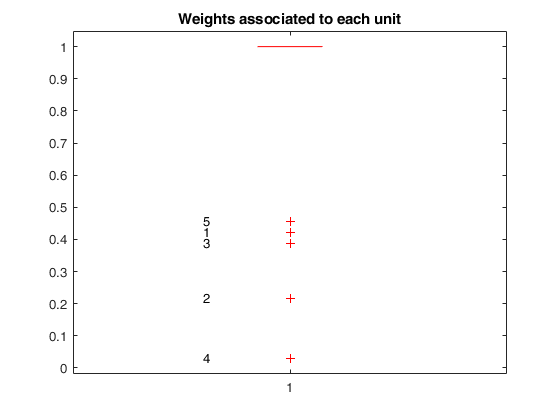
Related Examples
Input Arguments
Output Arguments
References
Cook, R.D., Holschuh N., and Weisberg S. (1982). A note on an alternative outlier model, "Journal of the Royal Statistical Society:
Series B (Methodological)", Vol. 44, pp. 370-376.
Thompson, R. (1985), A note on restricted maximum likelihood estimation with an alternative outlier model, "Journal of the Royal Statistical Society: Series B (Methodological)", Vol. 47, pp. 53-55.
Gumedze, F.N. (2019), Use of likelihood ratio tests to detect outliers under the variance shift outlier model, "Journal of Applied Statistics", Vol. 46, pp. 598-620.