mdLittleTest

mdLittleTest Little's test for Missing Completely At Random (MCAR).

Syntax

Description

Little's test assesses the null hypothesis that the missing-data mechanism is Missing Completely At Random (MCAR). The test is based on pattern-specific mean deviations from the global maximum likelihood estimate of the mean vector, using the corresponding submatrices of the global covariance matrix.

example

out =mdLittleTest(Y) Example 1: Little's MCAR test with default options.

example

out =mdLittleTest(Y, Name, Value) Example 2: Supply EM estimates externally.

Examples

expand all

  • Example 1: Little's MCAR test with default options.
  • Generate a data matrix with missing values and run the test using the internal EM estimates.

    rng(1);
    Y = randn(100,3);
    Y(rand(100,3)<0.15) = NaN;
    out = mdLittleTest(Y);
    disp(out)
               stat: 10.7470
                 df: 9
             pvalue: 0.2935
                 mu: [3×1 double]
              Sigma: [3×3 double]
           patterns: [7×3 logical]
          npatterns: 7
        patternInfo: [7×4 table]
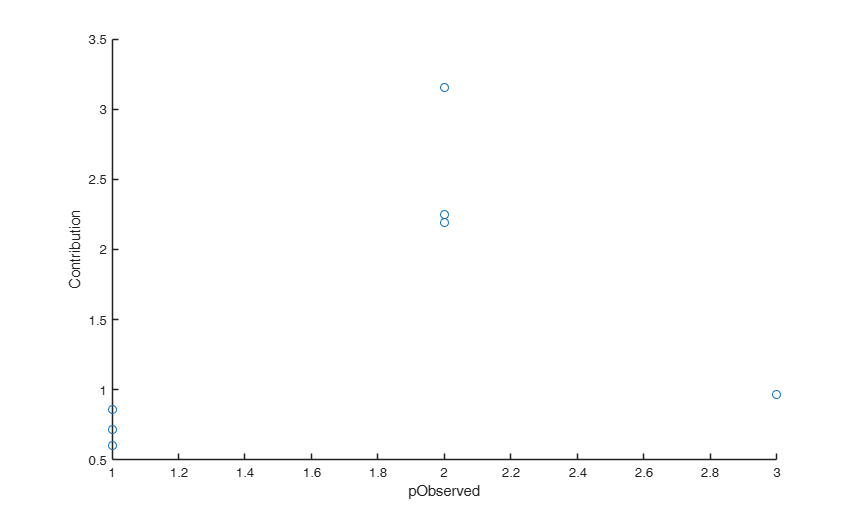
    
    
    Click here for the graphical output of this example (link to Ro.S.A. website).

  • Example 2: Supply EM estimates externally.
  • First compute the EM estimates using mdEM, then pass them to mdLittleTest.

    rng(2);
    Y = randn(150,4);
    Y(rand(150,4)<0.20) = NaN;
    outEM = mdEM(Y);
    out = mdLittleTest(Y,'emOut',outEM);
    disp(out.stat)
    disp(out.pvalue)
       32.5429
    
        0.2126
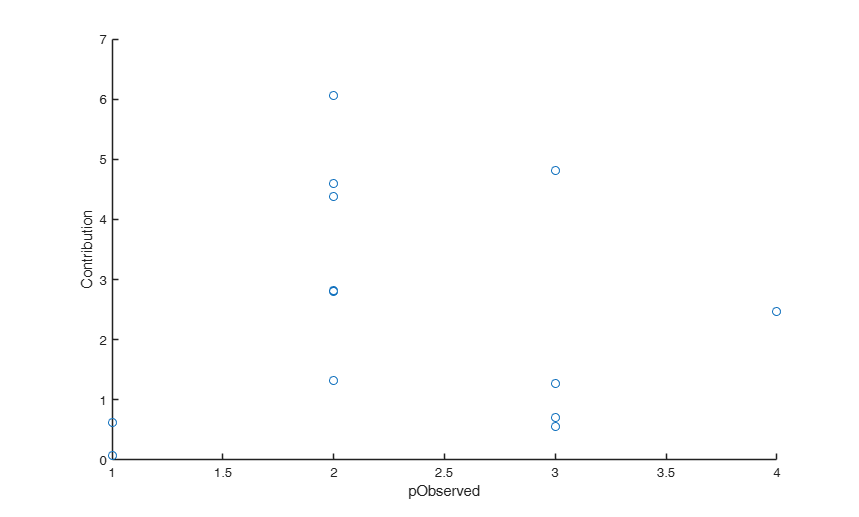
    
    
    Click here for the graphical output of this example (link to Ro.S.A. website).

    Related Examples

    expand all

  • Example 3: Inspect missingness patterns.
  • The output contains the distinct observed-data patterns and a table with information about the informative patterns.

    rng(4);
    Y = randn(120,4);
    Y(1:30,1) = NaN;
    Y(31:60,2) = NaN;
    Y(61:90,[3 4]) = NaN;
    out = mdLittleTest(Y);
    disp(out.patterns)
    disp(out.patternInfo)
       0   1   1   1
       1   0   1   1
       1   1   0   0
       1   1   1   1
    
             nPattern    pObserved    Contribution    CondSigma
             ________    _________    ____________    _________
    
        1       30           3           3.8363        1.7095  
        2       30           3           5.3496        1.2466  
        3       30           2          0.20649        1.4472  
        4       30           4            1.924        1.9194  
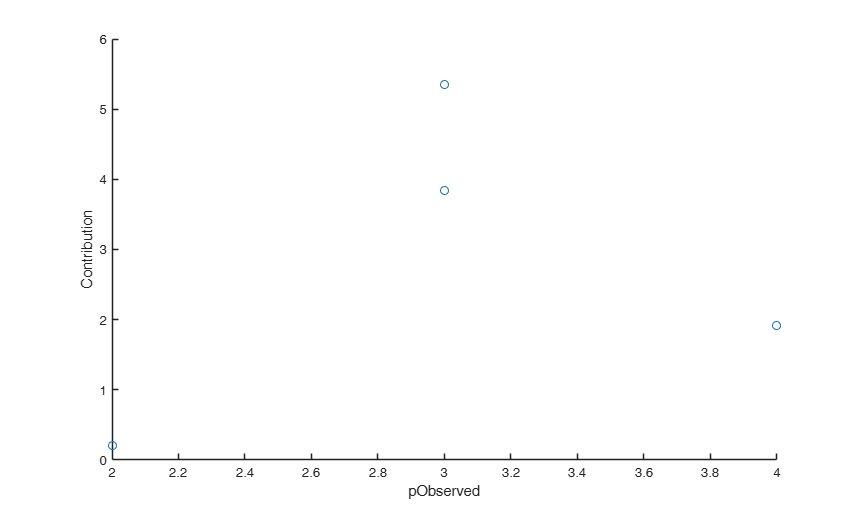
    
    
    Click here for the graphical output of this example (link to Ro.S.A. website)

  • Example 4: Data with rows completely missing.
  • Rows with all variables missing are ignored in the computation of Little's statistic.

    rng(5);
    Y = randn(80,3);
    Y(rand(80,3)<0.15) = NaN;
    Y(1:5,:) = NaN;
    out = mdLittleTest(Y);
    disp(out.npatterns)
    disp(out.stat)

    Input Arguments

    expand all

    Y — Input data. Matrix.

    n x p data matrix; n observations and p variables possibly containing missing values (NaN's).

    Rows of Y represent observations, and columns represent variables.

    Data Types: single | double

    Name-Value Pair Arguments

    Specify optional comma-separated pairs of Name,Value arguments. Name is the argument name and Value is the corresponding value. Name must appear inside single quotes (' '). You can specify several name and value pair arguments in any order as Name1,Value1,...,NameN,ValueN.

    Example: 'emOut',outEM , 'maxiter',100 , 'tol',1e-6 , 'msg',true

    emOut —Structure containing EM estimates.if supplied, it must contain fields: emOut.

    mu : p x 1 estimated mean vector emOut.Sigma: p x p estimated covariance matrix If empty, function mdEM is called internally.

    Default is [].

    Example: 'emOut',outEM

    Data Types: struct

    maxiter —Maximum number of iterations for mdEM.used only if option 'emOut' is empty.

    Default is 200.

    Example: 'maxiter',100

    Data Types: single | double

    tol —Convergence tolerance for mdEM.used only if option 'emOut' is empty.

    Default is 1e-7.

    Example: 'tol',1e-6

    Data Types: single | double

    msg —Display messages from mdEM.used only if option 'emOut' is empty.

    Default is false.

    Example: 'msg',true

    Data Types: logical

    Output Arguments

    expand all

    out — description Structure

    Structure containing the following fields:

    Value Description
    stat

    Little's test statistic.

    df

    Degrees of freedom of the chi-square reference distribution.

    pvalue

    p-value of the test.

    mu

    Global MLE of the mean vector.

    Sigma

    Global MLE of the covariance matrix.

    patterns

    R x p logical matrix. Each row is a distinct missingness pattern; true means observed entry.

    npatterns

    Number of distinct missingness patterns.

    patternInfo

    Table with one row for each informative pattern.

    More About

    expand all

    Additional Details

    Let r=1,...,R index the distinct missingness patterns. For pattern r, let n_r be the number of units following that pattern, let p_r be the number of observed variables in that pattern, and let \bar{y}_r be the sample mean vector computed using the observed variables only. Let \hat{\mu} and \hat{\Sigma} be the global maximum likelihood estimates under multivariate normality, typically obtained by EM. Denote by \hat{\mu}_r and \hat{\Sigma}_r the subvector and submatrix corresponding to the variables observed in pattern r. Little's statistic is \[ T = sum_r n_r * (\bar{y}_r - \hat{\mu}_r)' * \hat{\Sigma}_r^(-1) ... * (\bar{y}_r - \hat{\mu}_r). \]

    Under the null hypothesis of MCAR, T is asymptotically distributed as a chi-square random variable with degrees of freedom df = sum_r p_r - p where p is the total number of variables.

    Rows with all variables missing do not contribute to the test statistic.

    References:

    Little, R. J. A. (1988), "A Test of Missing Completely at Random for Multivariate Data with Missing Values", Journal of the American Statistical Association, 83, pp. 1198-1202.

    References

    Little, R. J. A. (1988), "A Test of Missing Completely at Random for Multivariate Data with Missing Values", Journal of the American Statistical Association, 83, pp. 1198-1202.

    See Also

    |

    This page has been automatically generated by our routine publishFS